8.27.2009

...the farce of the green colorway

It's been a while since I've gone on about the goings-on in local bike culture, so I thought I'd take this wet, cloudy day as an opportunity to reflect on some of the wackier developments in bicycle design and such...


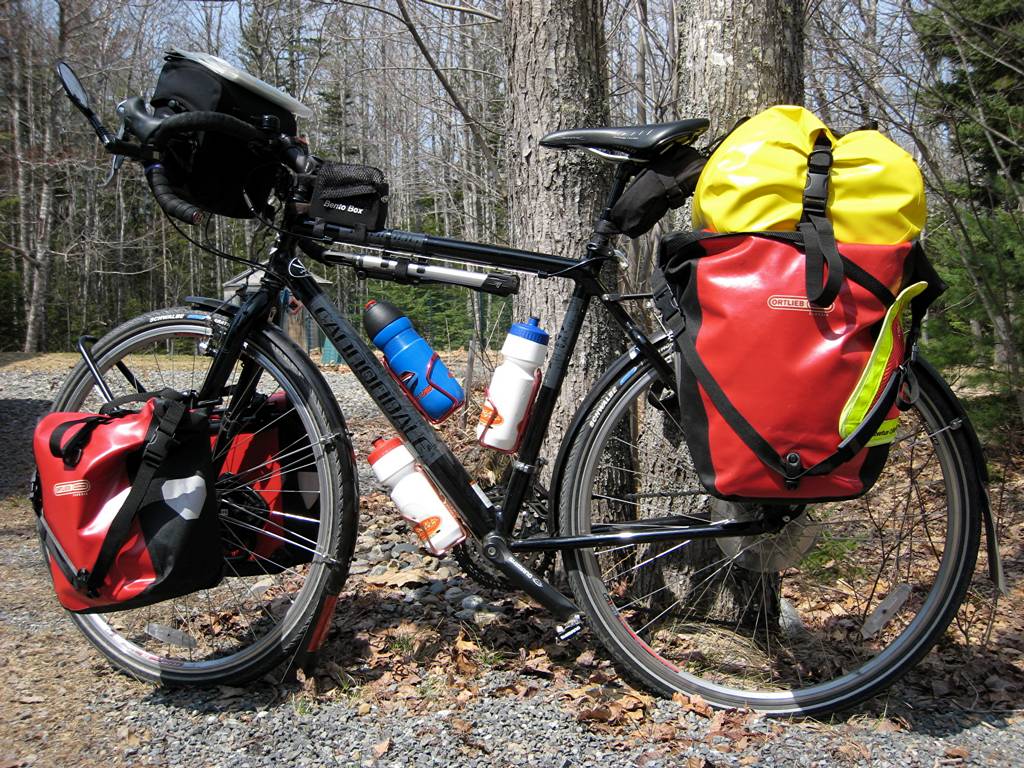
Not only have people been rethinking the weight capacity of bicycles, but as with any reasonably useful invention, people have been modifying and redesigning bikes to more and more utilitarian ends. The above example (which is found here and designed by Kevin Cyr of Boston) is a painting (by Cyr) of a so-called camper bike, featuring an RV-like ambiance and boasting all the comforts of a pedal-powered mobile home.

I think its a neat idea in a "salt of the earth" sort of way; being at once poetic and laughably annoying to use. I doubt I would ever have the determination to ride one of these cross country, my personal belief being that I can travel further faster on an unencumbered bike, though perhaps forgoing the comforts of RV life.

Though many do not share my sentiments for lightness and efficiency (like the pointless bike-powered water purifier that I mentioned a last week) and aren't content riding unencased.


This fringe group of anti-social cyclists has existed for almost as long as cycling itself has and still people are coming up with new ways to tackle the relatively simple problems day-to-day cycling presents... Like today's rain, for instance. Typically cyclists aren't too chagrined to don rain-pants, fenders, or to just ride in the rain and deal with being wet later. However not all cyclists are typical and a recent entry in the James Dyson Foundation design competition is a case-in-point:


Bike tents are no new concept, but somehow people can't get it through their thick skulls that approaches to peripheral cycling devices like this create more problems for the commuting or recreational cyclist than it solves. Sure, you may be able to keep your torso out of the rain (which is reasonably fresh water, by the way) but the severely hindered movement of air within the vinyl enclosure essentially guarantees you will arrive at your destination drenched in sweat (which isn't the freshest) unless its really chilly outside.

To be sure, much of 'design' these days is concerned with the packaging of things; people, products, and ideas are wrapped in strange enclosures, rendered to elicit emotional responses such as shame, fear, or libidinous thoughts.

Though one of the best ways to sell shit to people is to pander to their manufactured desire for "green" crap. I recently came across this bizarre bike that has successfully jumped onto the sustainability bandwagon:


Though I do love wooden things as well as new material approaches to age-old problems, a hollow wooden frame might not be the best solution for a road bike. God forbid you accidentally crash because that elegantly curved top tube is going to pierce you right below the sternum when (not if) that frame breaks. Furthermore, the amount of teak oil one will have to buy to keep this ride from cracking and decaying is daunting, not to mention the three pounds of lacquer they surely used; and nevermind all of the off-the-shelf parts that this wood bike boasts.

Swing and a miss...

In this interview with the "senior manager of sustainable growth" Barbara Chung for FIJI bottled water, we can witness the skillful feints and parries of a seasoned PR mouthpiece.

The dumb, "gettin' to know ya" questions were answered with a long winded (and very obviously rehearsed) statistics-based arguments, while the important ones that got to the root of the problem of calling yourself green and then engaging in flagrantly not-green practices went totally unanswered and ignored.

Though bottled water companies aren't the only ones who like to paint their misdeeds as noble; car companies and energy companies are some of the worst offenders. But picking on them is simply too easy. What really earns my ire is when people congratulate themselves for hurting the environment less than other people do.


The US Green Building Council which oversees the LEED rating and "awards" for buildings is a perfect example of this blindness to reality. Though I can tell you from experience that encouraging clients to spend the extra buck to build with less impact is difficult, rewards such as this are like patting yourself on the back for littering a little as opposed to a lot; the point is your littering, it doesn't really matter how much you do it, it's still bad.

Again, bicycles are a perfect example of this spin-doctoring. Organizations like TA love to tout the bike as a perfectly green solution for commuting, running errands, and generally looking hip; but are bicycles really that green?

Sure, when you pedal from place to place, you aren't using fossil fuels or belching tons of noxious gasses into the air as cars do, but to say that bicycles are good for the environment is a complete misnomer. Think about what bikes are made out of: metal, plastic, carbon fiber, and rubber. While you may not personally hurt the environment in your day to day use of your bike, the manufacturing of it (esp. carbon fiber) and transportation of it to your LBS, as well as the packaging for all the accouterments one will surely be suckered into buying for it does do harm.

So its fine to ride a bike or walk instead of taking a car, bus, or train; but one must remember that they're not actually helping anything, they're merely not hurting as much as they could.

As far as I'm concerned, theres only one cyclist who can lay claim to the title of greenest.

8.25.2009

...a quick book review

I've been immersed in the geeky, introverted world of science fiction literature lately, reading the first two novels in the Ender series by Orson Scott Card.


As I've admitted before, writing is not something I consider myself particularly good at, and as such I'm definitely not qualified to go critiquing others' writing in any scholarly way. However, I can remark on the aspects of style and plot with which I have some experience.

Ender's Game is set in the near future, immediately following what we are led to understand was a devastating intergalactic war with the only intelligent alien species known to man. The war ends in a pyrrhic victory for mankind and the remnants of earth's inhabitants have scrambled to establish a technologically advanced fleet of war ships and commanders in anticipation of future space battles.

Interestingly, the commanders drafted for service are genetically engineered (though biologically conceived) children from Earth. Ender Wiggin, the main character, is one of the few super-kids that manages to get accepted to an elite training school likened to an outerspace sort of West Point Academy. The majority of the book is centered around Ender's experiences at this school, and tackles age-old archetypes such as the insecure bully, self-important social climbers, and the book's ivory tower: the misunderstood genius child (which of course we are meant to personally identify with) who learns risilience toward the beratement of the former two.

While the sci-fi-ness of it all gets a little campy at times, for the most part, the book seems written with a sincerity uncommon amongst what could be called "entertainment literature". One almost forgets amid the parables and aphorisms that they are reading fantasy because the well developed characters and lush imagery bring an even better-developed social commentary and metaphysics to the fore. Among the more thought provoking topics discussed are morality of conflict, xenophobia, cencorship, hegemony, and of course, politics.

Unique to Card's writing is his ability to demand that you become emotionally attached to the way of life of the characters and the environment in which the reside. It embues your mind with magnificent ideals of a united humanity dressed in antebellum military tradition in the limitless frontier of space. It stokes one's lust for innovation and advancement, both of onesself and of society-at-large. I strongly reccomend that you give this book a try, even if you don't usually shop in the sci-fi paperback section of Barnes & Noble.

Typically my interest in the advancement of modes of transportation and habitation is of a decidedly more terrestrial nature, confined by silly things like gravity and friction. So naturally the idea of an architecture that is somewhat free of those constraints is compelling to say the least.

I've often cynically scowled at humanity's petty differences, so long unresolved that efforts at international cooperation are at best, comedic. I wonder if it would really take near-annhilation to unite men toward a common goal, to urge us over the Kármán line and into the infinite vaccum of space. To progress toward a truly advanced species, we'll have to devise a way to shed our feudal stranglehold on information and knowledge.

It is my belief that certain technologies should be strictly for the benefit of mankind as opposed to perpetuating the viscious cycle of ownership and entitlement. The confusion the native americans experienced with the idea that someone could "own"a piece of land is very similar to my sentiment regarding copyrighting and the perpetuation of capitalism.

One of the central tenets of technological advancement is to "make life easier" (or so we are led to believe) for the general public. Technologies that we currently enjoy cost money, which, as I've said before, is nothing more than a relatavistic denomenator of work accomplished. Because of this, advancing technologies don't actually make ones life any 'easier', it just makes it more tedious and specific.

For these reasons books like Ender's Game are somewhat depressing to me because I know that as human beings, it is essentially impossible for us to stop bickering about petty bullshit long enough to do something truly great like travel to other worlds or (gasp!) actually cure a disease. Despite the meddling of evil politicians and theocratic zealots in Card's version of future-Earth, people have somehow huddled together out of fear long enough to realize that for the most part, were more than the sum of our failures and internal conflict is counterproductive.

Though this book is nearly as old as I am and has enjoyed a wide readership to date, I encourage you to give it a read if you haven't already. And if you're one of those people that requires apochryphal accolades to persuade you, It recieved both the Hugo and Nebula awards which I suppose means that if it's that good in the eyes of sci-fi nerds, it'll knock your fucking socks off.

8.20.2009

...keepin it real Thursdays

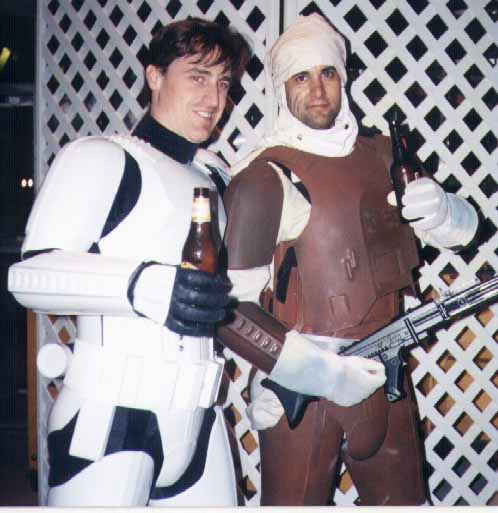
In keeping with this week's dorkiness-theme, I thought I'd relay this charming little snippet of intrigue that is unfortunately born of some hardcore real-ness.


Remember back in 2003 when space shuttle Columbia disintegrated on reentry (depicted above in all its sparkling horror)? Well, when it happened, lots of pieces of shuttle and crew rained down on Earth's surface as opposed to burning up as most earthly matter would. However, among the items recovered from Columbia's wreckage was, amazingly, the flight diary of an Israeli Astronaut named Ilan Ramon.


I haven't quite figured out how a bunch of paper managed to survive a 100km fall from just beyond the Kármán line at speeds approaching mach 7 (5,328.5 mph). Regardless, a group of astronauts and oragami masters in Japan have decided that based on this evidence, they will fold up about thirty miniature paper planes and release them from the a box on the exterior of the International Space Station, where they will begin a lazy descent back to Earth that is expected to take several months.

The planes will be printed with instructions in several languages requesting that the finder kindly notify Mr. Shinji Suzuki of the University of Tokyo's aerospace engineering program about when and where the plane was found.


I like this "expirement" because unlike the shuttle's violent and abrupt end while attempting to return home, the quiet and slow glide of the paper plane speaks of peace and moderation. Of course it is only possible due to its extreme lightness of construction, though it is a beautiful metaphor for the calmness and composure we should all strive for amid swirling social atmospheres that take us this way and that, unknowing and uncaring of our desired destination.

Speaking of strange things falling from the sky, in Greenpoint recently, two young perigrine falcons were rescued from gangs of pidgeons that were preemptively attacking their future predators. As I've heard, the adorable lil flappers are ok, as one is now at the Animal Medical Center and the other is apparently hiding in a bush near McGorlick park.


It most be something about New York City that fosters a gang mentality amongs the local animal populations. As I had noted a while back, dolphins were seen forming rival pods and established "turf" in our tidal estuaries.

Anywho, fly safe friends...

8.19.2009

...Video Wednesdays!

I came up with a brilliant post to write this morning on my commute in, but forgot what it was by the time I arrived at work. As I've said before, coming up with new material on a daily basis taxes my vocabulary and humorabulary equally.

As I read through my blogroll every morning, I have come to realize that blogs come in many different color-ways and shape-ways, though the prevailing style-way that I encounter on my daily travels is what I like to call the SPASM (Small-Posts-About-Singular-Matters) blog.

While many notable bloggers utilize this method of abundance (wwtdd, prolly, inhabitat), my personal preference is toward the ODE (Once-Daily-Entry) blogs such as my personal favorite, Bike Snob NYC, and the less verbose Velodramatic. I have nothing against blogs that post new things constantly, but I definitely tend toward the lyrical and paced ones where the writer earns a rapport amongst his readers by consistently bringing quality ideas and material to the fore.

As a man of principle, I take issue with the semantics of behavior; forthrightness on the internet not excluded. It usually doesn't bother me all that much when I see the same invention or idea repeated on more than one site on the same day (you gotta cut the news blogs some slack on this though, only so many noteworthy things happen each day), though it's when there is a several day or week long gap between re-postings that I get a little annoyed. I'm not sure why, but it bugs me to be re-fed images and opinions that have long been old news (or conjecture, the two are easily confused).

That said, I present for your general amusement three videos about bicycle dorks as they are in the wild:

First, the Steam Boat Willy; a hovercraft powered by a recumbent bicycle. Weird, I know...


And this next one is just silly...


I hate to say it, but this seems like a self-defeating invention because the water you purify (mind you using a $200+ CycleOps trainer) would be immediately needed for rehydration, right?

Lastly, this guy is a maniac. You may have seen this before, but in case you haven't...


That's all for tonight folks, ride safe tomorrow...

8.18.2009

... the parable of the bicycle

I was reading the blogs this morning and came across a tidbit of public design news that piqued my interest. Apparently Kent Ave is, as of yesterday, beginning a conversion into a northbound-only street for car and truck traffic. the bike lanes on either side of the current, two-way road will be combined into the rarely seen two-way bike lane.


I'm no sociologist or city planner, though I must express my apprehension about this move by the city. Though the multi-directionality will be preserved for bicycles, forcing southbound car and truck traffic through the middle of Hasidim will only serve to further strain the tenuous relationship between Williamsburg's landlords and their hipster tenants.

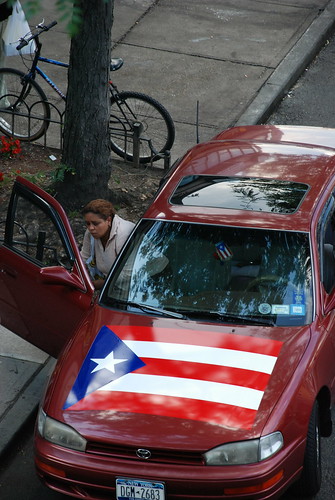
Wythe and Bedford Avenues are vital thoroughfares from Williamsburg through to Pratt (a known hipster breeding ground), and compose a significant portion of "The Great Hipster Silk Route." And though Hasids have raised a (metaphorical) stink about the immodest behavior of hipsters as they pass through their archaic enclave, they will likely find that a few bicycles is nothing compared to the rumbling delivery trucks and reggaeton-blasting Puerto Rico-mobiles that will be diverted into their lives.

On the topic of being resented for the pitfalls of society, I've officially become a jaded cyclist.

I commute to work in Manhattan from Brooklyn every single day I am able, as you no doubt have noted given the abundance of BLRI posts and road-use rants on this blog. In the eight months that I have unshackled myself from the MTA, my reactions to unfortunate traffic situations have morphed from a burning, holier-than-thou rage to passive irritation, and ultimately into the cold, stony ire of inward disdain that I am now only capable of emoting.

Whether I publicly acknowledged it or not, I've mentally flip flopped on a lot of issues in that time; Salmoning, bike lane abuse, and pedestrian oblivity top the list. I am torn between my desire to admonish idiots and intellectual modesty. I have tried numerous times to follow legal and socially acceptable routes of retribution to little or no avail; and conversely, I've also often done the exact opposite to similar effect.

Thankfully there are articles like this one, wherein commentors tragically berate one another with sweeping accusations and generalizations. I am reminded, while reading the shortsighted irritance, that life, like a bicycle, is composed of lots of different parts that serve a variety of useful functions.

While many people would like to think that they are the bottom brackets of the world (around which all power is revolved and within which it is stabalized), the truth is that most people are just cogs on the rear wheel of life; easily replaceable and fairly cheap.

Then there are those who (however necessary it may be) hinder progress by squeezing those who carry the weight of the machine; the brakes to wheels, if you will.

Still, there are the dork disks and spoke-reflectors of society that enjoy a federally mandated existence regardless of their pointlessness and ineffectiveness.

Lastly (that I can draw an allusion to right now, anyway) is the saddle, the ass sweat-soaked ivory tower upon which the bloated rump of reality sits. These are the rare idealists and thinkers who know no better existence than altruistic pursuits of widespread peace and comfort. Their job is a thankless one, and resenting that fact, are known to imitate the petty tomfooleries of other ignored parts, though to much more dramatic ends: (warning: NSFW)